
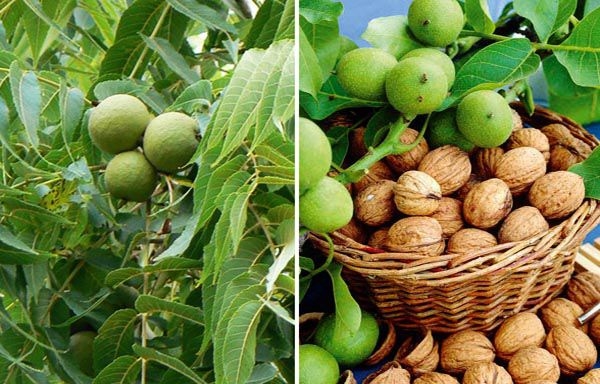
Hello! Today we explore the precious nut dubbed "queen of nuts" with countless wonderful benefits – the Walnut Tree (Juglans regia) – both a nutritious food and a valuable medicinal plant supporting many conditions. Let's find out the details together!
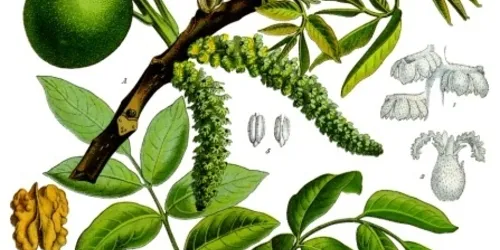
📸 [Photos 1 and 2 – Illustration and real images of the Walnut Tree]
I. GENERAL INTRODUCTION TO THE WALNUT TREE
Walnut (scientific name: Juglans regia) is a flowering plant species in the genus Juglans of the family Juglandaceae. This species was first scientifically described by Carl von Linné in 1753. The walnut tree is distributed from the eastern Balkans through the Himalayas to southwestern China. The largest walnut forests are in Kyrgyzstan, at an altitude of 1,000 to 2,000 m above sea level.
🌱 Identification features
- • Trunk: Large, thick, gray-ash bark with longitudinal cracks. Trunk radius can be large.
- • Leaves: Odd-pinnate compound leaves, alternate. Each leaf consists of about 5 to 9 small leaflets.
- • Flowers: Grow in squirrel-tail-shaped catkins about 10 cm long, containing many small flowers inside.
- • Fruit: Has a green outer husk when young. Inside is a brown hard shell enclosing the kernel.
- • Seed: The kernel has many lobes and deep wrinkles, looking very much like a small brain.
II. HISTORY AND ORIGIN
The walnut tree originates from Central Asia, ancient Persia (modern Iran) and the Himalayan region, then spread to the Mediterranean, Europe and North America.
📜 Origin and ancient distribution
- Fossil record: The Persian walnut appeared about 3.45 million years ago.
- Native range: Extends from the eastern Balkans, through the Himalayas to southwestern China. Black and white walnuts also originate from North American valleys.
- Antiquity: Ancient Persians and Romans cultivated and traded this fruit. Romans called it "Juglans", meaning "Jupiter's soup fruit".
🌏 Expansion and development process
- Silk Road: The walnut tree followed merchants' footsteps spreading throughout the Eurasian continent.
- In Asia: The tree appeared since the Han dynasty in China and gradually adapted to the mountainous regions of northern Vietnam.
- Name: The shape of the kernel inside with many wrinkles resembles an animal brain, hence popularly called walnut (óc chó).
III. GROWTH CHARACTERISTICS AND IDEAL LIVING CONDITIONS
a. Ecological characteristics
- Perennial large tree, prefers temperate and subtropical climate.
- Rich in Omega-3, antioxidants and minerals.
b. Care conditions for always green and healthy plants
- 🌡️ Temperature: Best temperature 20 – 32°C.
- 💧 Rainfall: Required rainfall 1500 – 2000 mm/year.
- ☀️ Growing area: Few storm winds, sufficient sunlight.
- 🌱 Soil: Loose, fertile, nutrient-rich. Good drainage, not waterlogged in rainy season.
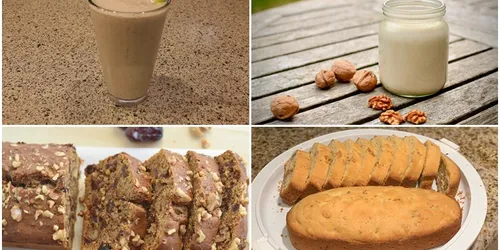
📸 [Photo 3 – Images of walnut kernel and applications of Walnut]

📸 [Photos 4 and 5 – Images of dishes and applications of Walnut]
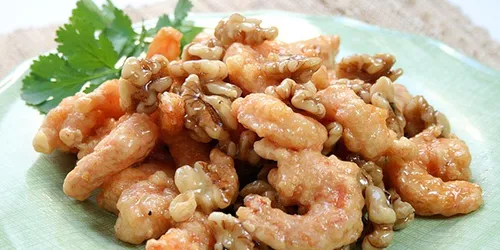

📸 [Photo 6 – Images of dishes and applications of Walnut]
IV. NUTRITIONAL COMPOSITION AND DIVERSE BENEFITS
a. Nutritional composition
Nutritional composition of the kernel (per 30g):
- 🧈 Fat: 18.5g (mainly healthy fatty acids).
- 💪 Protein: 4.3g.
- 🌾 Fiber: 1.9g.
- 🍚 Carbohydrates: 3.9g.
- 💧 Water: About 4%.
Chemical composition of other parts:
- 🍃 Leaves and bark: Contain large amounts of tannin (9–12%), juglone, inositol and gallic acid.
- 🌰 Young fruit/husk: Contain alpha-hydrojuglone glycoside which upon hydrolysis yields biologically active substances.
b. Remarkable benefits
- 🌰 Walnut kernel: Rich in Omega-3, antioxidants and minerals. Helps lower blood lipids, protect cardiovascular and stabilize blood sugar. Supports digestion, good for brain and pregnant women. Strengthens health, reduces back and knee pain.
- 🍃 Walnut leaves and husk: Have antiseptic properties, help tighten skin. Support blood purification and improve some dermatological problems.
- 🫒 Walnut oil: Supports moisturizing, limits itching, eczema. Used for natural black hair dyeing.
V. PROPAGATION TECHNIQUES AND DETAILED CARE
a. Propagation
🌱 Seed propagation (sexual):
- Seed selection: Take healthy, disease-free walnuts.
- Seed treatment: Cold stratification by wrapping seeds in a damp cloth, placing in a plastic bag in the refrigerator for 1 to 3 months to break dormancy.
- Sowing and transplanting: Sow in suitable weather. When seedlings have 2 cotyledons, transfer to forest soil bags mixed with a little phosphorus, shade about 25%.
🌱 Grafting propagation (asexual):
- Rootstock: Use seedlings from seed 1.5 - 2 years old, root collar diameter 1.2 to 2.0 cm.
- Scion: Choose healthy young branches 8 - 12 months old.
- Season and method: Usually side grafting method is applied around December to January of the following year.
- Post-grafting care: Shade 25% and seal the grafting bed tightly to retain heat and promote rapid union. Nursery exit standard: tree 50 - 80 cm tall, graft eye healthy.
b. Care and disease prevention
- 💧 Watering and weeding: Water young trees regularly, keep soil moist but not waterlogged. Clear weeds around the base monthly to avoid hiding pests. Mound the base higher after weeding for good drainage.
- 🌾 Fertilizing: Fertilize from the second year after planting. Use about 0.5 – 1 kg NPK per base at the beginning of the rainy season each year. Spread around the base then cover with soil; water if it doesn't rain.
- ✂️ Branch pruning: Cut weak small branches, diseased or old branches. Form a moderately low tree shape for easy care and harvest. Install support stakes for trees over one year old so they don't fall in storm winds.
🛡️ Pest and disease prevention:
- Cultivation and preventive measures: Clean weeds and dry leaves around the base to limit hiding places for stem borers. Water moderately, make good drainage channels to avoid waterlogging causing root rot. Fertilize balanced to keep the tree healthy.
- Stem borers, leaf-eating insects: Check the tree weekly. Cut severely diseased branches, paint the base with lime or spray safe insecticide.
- Fungal diseases, aphids: Prune branches to aerate the canopy. Use sticky traps or specific medicine when pests first appear.
VI. REMEDIES SUPPORTING DISEASE TREATMENT
⚠️ Important note:
This is a folk remedy, not scientifically proven, for reference only.
- Parts used: Seeds, leaves, branches, shoots, husk.
- Harvest season:
• Duration: About 3 months (from late summer to late autumn).
• Recognition signs: The outer green husk changes color, dries and cracks open to reveal the hard shell inside.
• Tree age: A tree from seed or seedling takes about 5 to 7 years (sometimes longer depending on variety) before giving stable harvest. - Preparation form: Fresh and dried.
- Taste:
• Walnut kernel: Sweet taste, slightly astringent, warm nature.
• Branches and leaves: Bitter astringent taste, neutral nature. - Benefits:
• Kernel (Hồ đào nhân): Tonifies liver and kidneys, strengthens lower back and knees, lubricates intestines, tonifies lungs and calms asthma. Often used for kidney deficiency, cough asthma, body weakness, lower back and knee pain and constipation.
• Leaves: Tighten skin, antiseptic and purify blood. Often used as anti-inflammatory, deworming or bath water for skin diseases.
• Outer husk of fruit: Used as a substitute for leaves due to antiseptic and astringent properties. Or dried and incorporated into traditional recipes.
• Shoots (or young branches): In folk medicine, fresh walnut shoots are often crushed to extract juice, mixed with chive leaves to support treatment of cardiovascular diseases (such as heart valve regurgitation).
• Internal membrane of fruit (Phân tâm mộc): The thin membrane separating the kernel lobes inside the walnut is also harvested to treat insomnia, nocturnal emissions or bedwetting.
🌰 Thank you for reading this article!
I hope you gained much useful knowledge about this nutritious precious nut.
Don't forget to follow the blog for more interesting information!
📌 Share the article if you found it helpful!
Comments (0)
No comments yet.
Leave a Comment