
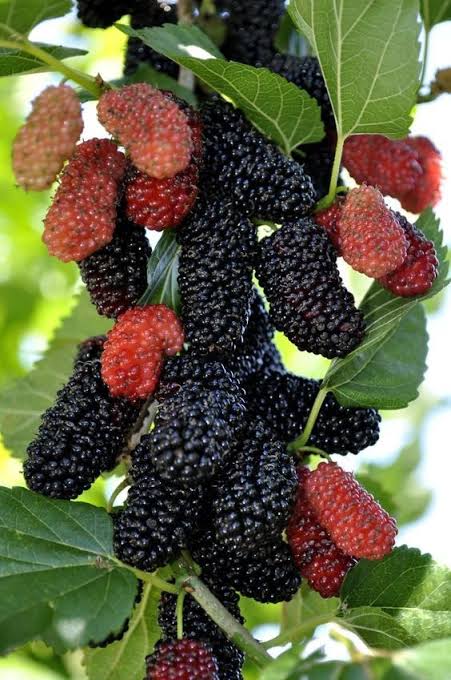
Hello! Today we explore a tree closely linked to the traditional silk weaving industry and with countless wonderful benefits – the Mulberry Tree (Morus alba L) – both a food source for silkworms and a valuable medicinal plant supporting many conditions. Let's find out the details together!
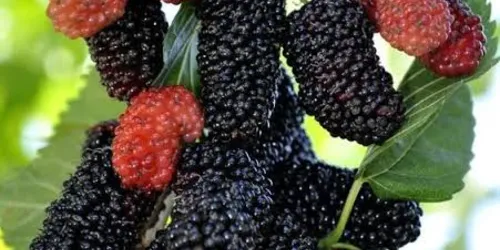
📸 [Photos 1 and 2 – Illustration and real images of the Mulberry Tree]
I. GENERAL INTRODUCTION TO THE MULBERRY TREE
Mulberry (scientific name: Morus alba L) also called white mulberry, common mulberry, white mulberry, local mulberry, is a flowering plant species in the genus Morus of the family Moraceae. This species was first scientifically described by Carl Linnaeus in 1753. The tree was initially cultivated mainly for its leaves to feed silkworms for the silk weaving industry.
🌱 Identification features
- • Trunk and branches: Woody, branches soft and hairy when young, smooth at maturity, gray-white bark and milky white latex.
- • Leaves: Simple alternate leaves, blade elongated oval or heart-shaped, edges finely serrated, basal veins clearly prominent.
- • Flowers: Unisexual flowers monoecious or dioecious, without petals; male flowers in racemes, female flowers in squirrel-tail catkins.
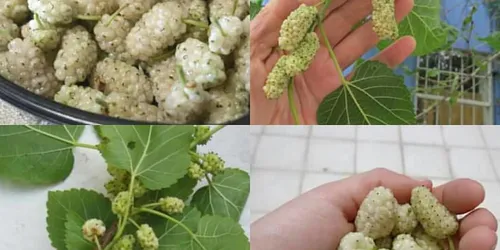
- • Fruit: Cylindrical compound fruit; white-green when young, turning red then dark black when ripe, sweet slightly sour taste.
II. HISTORY AND ORIGIN
Mulberry originates from the region of East Asia, especially ancient China. This tree was initially cultivated mainly for its leaves to feed silkworms for the silk weaving industry, then spread to many Asian countries and the world.
📜 Origin in China
- Ancient domestication: Began to be domesticated and cultivated about 5,000 years ago.
- Sericulture: Closely linked to silkworm rearing for silk (sericulture).
- Silk Road: Silk was a precious trade commodity on the ancient Silk Road.
🌏 Spread to the world
- Asia: Following merchants and diplomatic activities to Korea, Japan and Southeast Asian countries.
- Vietnam: Mulberry adapts well to the climate, linked to traditional mulberry cultivation and silkworm rearing craft villages.
- Europe and America: Later introduction through global silk industry development efforts.
III. GROWTH CHARACTERISTICS AND IDEAL LIVING CONDITIONS
a. Ecological characteristics
- Perennial tree, prefers warm climate.
- Rich in vitamins C, A, E, K and antioxidants anthocyanins, flavonoids.
b. Care conditions for always green and healthy trees
- 🌡️ Temperature: Tree germinates from 12°C, grows strongly at 24–32°C; stops growth below 0°C or above 35–40°C.
- ☀️ Light: Prefers full light, needs 10–12 hours of lighting per day for thick and green leaves.
- 💧 Water: Needs sufficiently moist watering, ideal soil moisture 70–80%; tree tolerates drought poorly with prolonged water shortage.
- 🌱 Soil: Suitable for soils with arable layer over 1m, well-drained, pH 6.5–7 (wide adaptation 4.5–9.0).
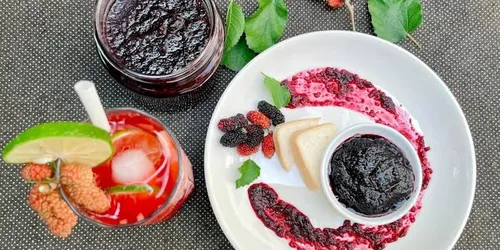
📸 [Photos 3 and 4 – Images of mulberries and applications from Mulberry]
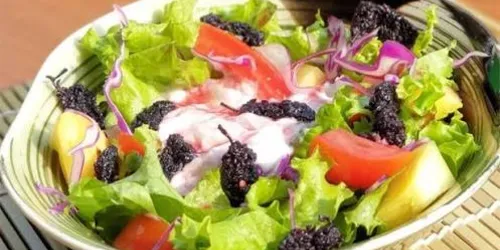
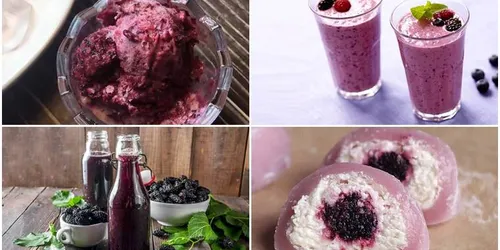
📸 [Photos 5 and 6 – Images of mulberries and applications from Mulberry]

IV. NUTRITIONAL COMPOSITION AND DIVERSE BENEFITS
a. Nutritional composition
Nutritional composition of fresh mulberries (per 100g):
- 💧 Water: About 88%.
- 🍚 Carbohydrates: 9.8g (mainly natural sugars like glucose and fructose).
- 🌾 Fiber: 1.7g (including soluble and insoluble fiber).
- 💪 Protein: 1.4g.
- 🧈 Fat: 0.4g.
- 🍊 Vitamins and minerals: Rich in vitamins C, A, E, K as well as minerals like iron, potassium, calcium and magnesium.
- 🧬 Antioxidants: Contain large amounts of anthocyanins and flavonoids protecting cells.
b. Remarkable benefits
- 💪 Blood tonic, calming: Supports treatment of insomnia, dizziness, vertigo and anemia.
- 🌾 Digestive support: Helps lubricate the intestines, reduce constipation and improve intestinal function.
- ⚖️ Blood sugar control: Helps stabilize blood sugar thanks to natural compounds.
- 🛡️ Boosts immunity: Provides many vitamins and antioxidants to enhance the immune system.
- ✨ Beauty, anti-aging: Nourishes bright, smooth skin and prevents premature aging.
- 🍽️ Common consumption methods: Fresh consumption, syrup/juice, jam, alcohol maceration.
V. PROPAGATION TECHNIQUES AND DETAILED CARE
a. Propagation
🌱 Selection of seedling branches:
- Choose semi-mature branches (not too young or too old), about 15–20 cm long.
- Branches with 2–4 healthy dormant buds, disease-free.
- Cut the base of the cutting at an angle with a sharp knife to increase contact area with soil.
🌱 Treatment and cutting:
- Dip the cutting base in rooting hormone (if available) to increase survival rate.
- Insert the cutting into an earth pot or pot with loose soil, mixed with a little sand or coconut fiber for good drainage.
- Place the pot in a shady place, avoid direct sunlight.
🌱 Care after cutting:
- Water by spraying to maintain soil and cutting moisture regularly.
- After about 4 to 6 weeks, the branch will produce roots and new shoots.
- When the seedling is healthy (over 2–3 months), it can be taken to the garden for permanent planting.
b. Care and disease prevention
- ☀️ Light and Watering: The tree loves plenty of sun. Place the pot or plant in a bright, airy place (6–8 hours of sun/day). Water regularly to keep the soil moist but avoid waterlogging.
- 🌾 Fertilizing and Pruning: Apply organic fertilizer or NPK every fortnight to nourish the tree. Prune old leaves, withered leaves and small branches. Pinch tips, cut branches periodically to stimulate new shoots and fruit at leaf axils.
🛡️ Pest and disease prevention:
- Leaf-eating pests (cutworms, leaf rollers): Pick by hand, shake the tree so worms fall onto a tarp for collection, or use sunflower traps. Spray biopesticide containing Emamectin benzoate when worms are small and isolate for 15 days before picking leaves for silkworms.
- Aphids (scale insects, mealybugs): Cut and burn severely affected branches. Use a mixture of soap and kerosene or a sulfur-lime solution to spray, wipe.
- Stem borers: Cut severely bored branches, clean roots after each cutting season.
- Leaf spot diseases, rust, powdery mildew, leaf scorch: Apply balanced NPK fertilizer, avoid excess nitrogen. Apply lime or phosphorus to improve acidic soil, avoid waterlogging. Collect and destroy diseased leaves, plow soil and expose roots in winter to kill pupae and hidden pathogens.
VI. REMEDIES SUPPORTING DISEASE TREATMENT
⚠️ Important note:
This is a folk remedy, not scientifically proven, for reference only.
- Parts used: Leaves, root bark, fruit, branches.
- Harvest season:
• Mulberry fruit harvest: North late March to early April; South April to May. Harvest duration about 2 to 4 weeks.
• Mulberry leaf harvest (for silkworm rearing): First harvest about 6 months after planting. Continuous harvest divided by spring, summer and autumn. - Preparation form: Fresh and dried.
- Benefits:
• Mulberry leaves (Sang ye): Help reduce fever, treat colds, expectorate, brighten eyes and support hypertension treatment.
• Root bark (Sang bai pi): Part of the root bark scraped of the outer dry cork layer, has diuretic effect, treats cough with phlegm, asthma and reduces edema.
• Mulberry branches (Sang zhi): Use of young branches, has the effect of eliminating rheumatism, reducing joint pain and treating paralysis of hands and feet.
• Mulberries (Sang shen): Help tonify kidneys, brighten eyes, nourish blood, treat insomnia, supplement antioxidants and treat premature white hair.
🍇 Thank you for reading this article!
I hope you gained much useful knowledge about this tree linked to traditional craft villages.
Don't forget to follow the blog for more interesting information!
📌 Share the article if you found it helpful!
Comments (0)
No comments yet.
Leave a Comment