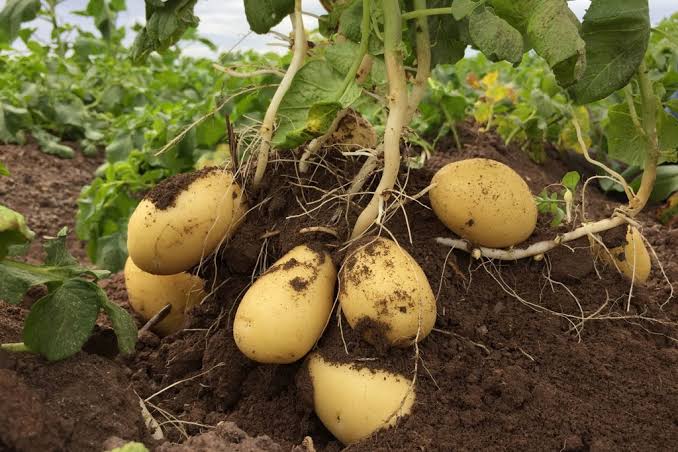
Hello! Today we explore the familiar tuber that is a staple in daily meals – Potato (Solanum tuberosum) – one of the world's most important food crops, both nutritious and a precious remedy supporting many health conditions. Let's dive in!
📸 [Photo 1 & 2 – Simulated and real images of Potato]


I. INTRODUCTION TO POTATO
Potato (scientific name: Solanum tuberosum) is a short-day agricultural crop belonging to the nightshade family (Solanaceae), grown for its starchy tubers. They are the world's most widely grown tuber crop and the fourth most important food crop in terms of fresh production – after rice, wheat, and corn. Long-term potato storage requires cold conditions.
🌱 Identification Features
- • Origin: Native to the Andes mountain region in South America (Peru and Bolivia).
- • Stems, Roots and Tubers: Root system is shallow (~60cm). Tubers are swollen underground stems that store nutrients. Each plant produces 3-25 tubers.
- • Leaves and Flowers: Pinnately compound leaves. Flowers are white, pale purple or pinkish with yellow stamens. Self-pollinating.
- • Life Cycle: 80-120 days depending on variety and conditions.
II. HISTORY AND ORIGIN
Potato originates from the Andes mountains in South America (present-day Peru and Bolivia), where indigenous people domesticated them over 7,000 years ago. The plant was brought to Europe by Spanish explorers in the 16th century, before spreading globally and becoming one of the world's most important food crops.
III. GROWTH CHARACTERISTICS AND IDEAL CONDITIONS
a. Ecological Characteristics
- Short-day crop, prefers cool climate.
- Tubers rich in starch and nutrients.
b. Care Conditions for Lush Growth
- 🌡️ Temperature: Daytime 18-22°C, nighttime 10-15°C. Above 30°C inhibits tuber formation.
- 🌱 Soil: Loose, humus-rich, well-drained, pH 5.0-6.5.
- 💧 Moisture: 70-80%, avoid waterlogging.
- ☀️ Light: Sun-loving, needs adequate light for photosynthesis.
- 🌾 Nutrition: Needs high potassium for tuber size and quality.
📸 [Photo 3 & 4 – Dishes from Potato]


IV. NUTRITIONAL COMPOSITION AND VERSATILE USES
a. Nutritional Components (per 100g)
- 🥔 Energy: 94 kcal.
- 💧 Water: ~75g.
- 🍚 Carbohydrates: ~21g (2.1g fiber).
- 🥩 Protein: ~2.1g.
- 🦴 Minerals: Potassium (544mg), Phosphorus, Magnesium, Iron.
- 🍊 Vitamins: Vitamin C (~12mg), Vitamin B6, Folate.
b. Wonderful Applications
- ❤️ Heart health: Potassium helps regulate blood pressure, reduces stroke risk.
- 🥗 Digestion and immunity: Fiber aids digestion, vitamin C boosts immunity.
- 💄 Beauty: Potato juice moisturizes, reduces dark circles, brightens skin.
V. PROPAGATION AND CARE TECHNIQUES
a. Propagation
🌱 Seed tuber selection:
- Choose uniform tubers (35-50g), smooth skin, disease-free.
- Large tubers (>70g) cut into pieces 30-40g, each with 1-2 healthy eyes.
🌱 Sprouting and planting:
- Let cuts dry or roll in wood ash. Place tubers in trays in a cool place, mist until sprouts reach 1-2cm.
- Density: rows 60-70cm apart, plants 25-30cm apart. Place tubers horizontally, sprouts up, cover with 3-5cm soil.
b. Care and Disease Prevention
- 💧 Watering: Keep soil moisture 65-70%, avoid waterlogging. Important in first 60-70 days.
- 🌾 Hilling and weeding: Hill twice: first after 15-20 days (10-15cm high), second when plant reaches 30-40cm.
- 🌱 Fertilization: Top dress twice: first when plant 10-15cm (NPK), second at flowering (add Potassium).
🛡️ Pest and Disease Management:
- Moisture control: High beds, good drainage, avoid flooding.
- Balanced fertilization: Avoid excess nitrogen, increase phosphorus and potassium.
- Field hygiene: Prune old leaves, remove diseased plants.
- Disease treatment: Spray copper-based fungicides preventively when humidity is high.
VI. SUPPORTIVE REMEDIES
⚠️ Important Note:
This is a folk remedy without scientific validation – for reference only.
- Part used: Stems and tubers.
- Harvest season: Winter (Oct 15-Nov 15), Spring (December), Autumn (August-October).
- Preparation: Can be used fresh or dried.
- Taste & Nature: Sweet taste, neutral nature.
- Uses: Heart health, digestion, skin beauty, vitamin C source.
📝 Health Support Benefits:
- Stomach ulcers: Fresh potato juice reduces stomach acid, heals mucosa.
- Burns and dermatitis: Apply crushed or sliced potato to soothe skin.
- Blood pressure: High potassium helps dilate blood vessels, reduces pressure.
- Anti-inflammatory and pain relief: Antioxidants reduce arthritis symptoms.
- Laxative: Fiber stimulates digestion, prevents constipation.
🌱 Thank you for reading!
We hope you found useful information about this golden staple food.
Don't forget to follow our blog for more interesting content!
📌 Share if you found this helpful!

Comments (0)
No comments yet.
Leave a Comment