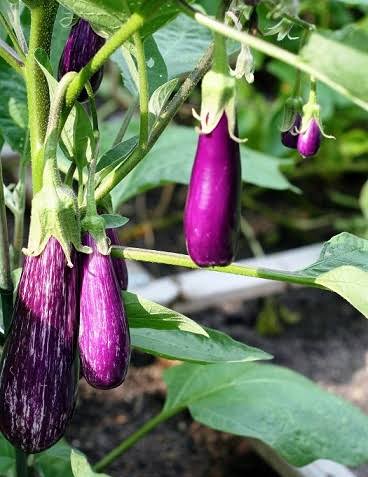
Hello! Today we explore the familiar purple fruit that is a staple in daily meals – Eggplant (Solanum melongena) – a nutritious food and a precious remedy supporting many health conditions. Let's dive in!
📸 [Photo 1 & 2 – Simulated and real images of Eggplant]


I. INTRODUCTION TO EGGPLANT
Eggplant (scientific name: Solanum melongena) is a plant species belonging to the nightshade family (Solanaceae), with the fruit of the same name commonly used as a vegetable in cuisine. Eggplant is closely related to tomatoes, potatoes, and peppers, and originates from southern India and Sri Lanka. It is an annual plant, reaching 40-150 cm in height, typically with spines, large rough-lobed leaves, 10-20 cm long and 5-10 cm wide. Flowers are white or purple, with a five-lobed corolla and yellow stamens.
🌱 Identification Features
- • Stem: Herbaceous or slightly woody at the base, highly branched, green or light purple, may have small spines.
- • Leaves: Large simple leaves, alternate, broad lobed blades, soft hairs on the underside.
- • Flowers: Solitary or in small clusters in leaf axils, light purple or white, 5 petals, yellow stamens.
- • Fruit: Berry, diverse shapes (long, oval, round), smooth glossy skin, dark purple, light purple or white. Spongy white flesh with many small seeds.
II. HISTORY AND ORIGIN
Eggplant originates from South and Southeast Asia, specifically southern India, Sri Lanka, or the India-Myanmar border region. This plant has been domesticated since prehistoric times. From India, eggplant spread to China, Southeast Asia, the Middle East, Africa, and Europe, becoming one of the most popular vegetables worldwide.
III. GROWTH CHARACTERISTICS AND IDEAL CONDITIONS
a. Ecological Characteristics
- Annual plant, herbaceous, prefers warm climate.
- Fruit rich in nutrients and antioxidants.
b. Care Conditions for Lush Growth
- 🌡️ Temperature: Ideal 25-30°C. Below 20°C or above 35°C poor development.
- ☀️ Light: Extremely sun-loving, needs direct sunlight all day.
- 🌱 Soil: Light loam, sandy loam, alluvial soil, rich in organic matter, well-drained, pH 5.5-6.5.
- 💧 Water: Maintain moisture ~80%. Needs plenty of water during flowering and fruiting. Avoid drought or waterlogging.
📸 [Photo 3 & 4 – Dishes from Eggplant]


📸 [Photo 5 & 6 – Dishes and applications of Eggplant]


IV. NUTRITIONAL COMPOSITION AND VERSATILE USES
a. Nutritional Components (per 100g)
- 💧 Water: 92-93%.
- 🍚 Energy: 15-25 kcal.
- 🍊 Vitamins: C, B6, E.
- 🦴 Minerals: Potassium, Phosphorus, Calcium, Iron.
- 🧬 Antioxidants: Anthocyanins (characteristic purple color).
b. Wonderful Applications
- ❤️ Heart health: Potassium, fiber, antioxidants reduce bad cholesterol, stabilize blood pressure.
- ⚖️ Weight management: Low calories, high fiber creates feeling of fullness.
- 🧠 Memory boost: Nasunin (in purple skin) protects brain cells.
- 🥗 Digestion: Fiber promotes bowel movement.
- 🩸 Blood sugar control: Slows sugar absorption.
V. PROPAGATION AND CARE TECHNIQUES
a. Propagation
🌱 Seed Selection and Treatment:
- Choose large, uniform, healthy fruits from the 2nd or 3rd harvest.
- Soak seeds in warm water (50°C) for 10-15 minutes to kill fungi.
- Continue soaking in clean water for 24-30 hours, then germinate in a damp cloth at 25-30°C until sprouting.
🌱 Seedling Growing:
- Mix fine soil with well-rotted manure or coconut coir, husk.
- Sow seeds in pots or beds, cover with 0.5-1 cm of soil.
- Mist regularly to maintain moisture.
b. Care and Disease Prevention
- ☀️ Light: Needs at least 6 hours of sunlight/day.
- 💧 Watering: Once daily in sunny season, water early morning or late afternoon. Avoid waterlogging.
- 🌾 Fertilization: Apply worm castings, NPK periodically after 2-3 weeks.
- ✂️ Pruning: Remove side branches and old leaves below the first flower cluster.
🛡️ Pest and Disease Management:
- Fruit and shoot borers: Larvae damage young shoots and fruits.
- Thrips: Suck sap causing curled leaves, stunted growth.
- Red spider mites: Feed on leaf undersides causing yellowing and dropping.
- Bacterial wilt: Remove diseased plants, treat soil with lime powder.
- Powdery mildew: Prune old leaves, spray copper-based fungicides.
VI. SUPPORTIVE REMEDIES
⚠️ Important Note:
This is a folk remedy without scientific validation – for reference only.
- Part used: Fruit, leaves, roots.
- Harvest season: Winter-Spring (Sept-March), Summer-Autumn (April-July). Fruits 60-75 days after planting, harvest lasts 4-5 months.
- Preparation: Can be used fresh or dried.
- Taste & Nature: Cooling nature, sweet taste.
- Uses: Heart health, weight loss, blood sugar control, antioxidant.
📝 Supportive Remedies:
- Lower blood pressure: Boil eggplant, mix with garlic and ginger, eat with rice.
- Hematuria: Boil whole fruit with stem, drink the water.
- Detoxify: Juice fresh eggplant or make soup.
- Joint pain relief: Chop eggplant, soak in boiling water, strain and drink.
- Age spots: Eat cooked eggplant daily.
⚠️ Important Precautions:
- Do not eat too much: Contains Solanine which can cause poisoning.
- Avoid eating raw: Always cook thoroughly to break down toxins.
- Cold-natured people should avoid: May worsen conditions.
- Food incompatibilities: Avoid combining with duck, goose, or seafood.
🌱 Thank you for reading!
We hope you found useful information about this purple nutritious fruit.
Don't forget to follow our blog for more interesting content!
📌 Share if you found this helpful!



Comments (0)
No comments yet.
Leave a Comment