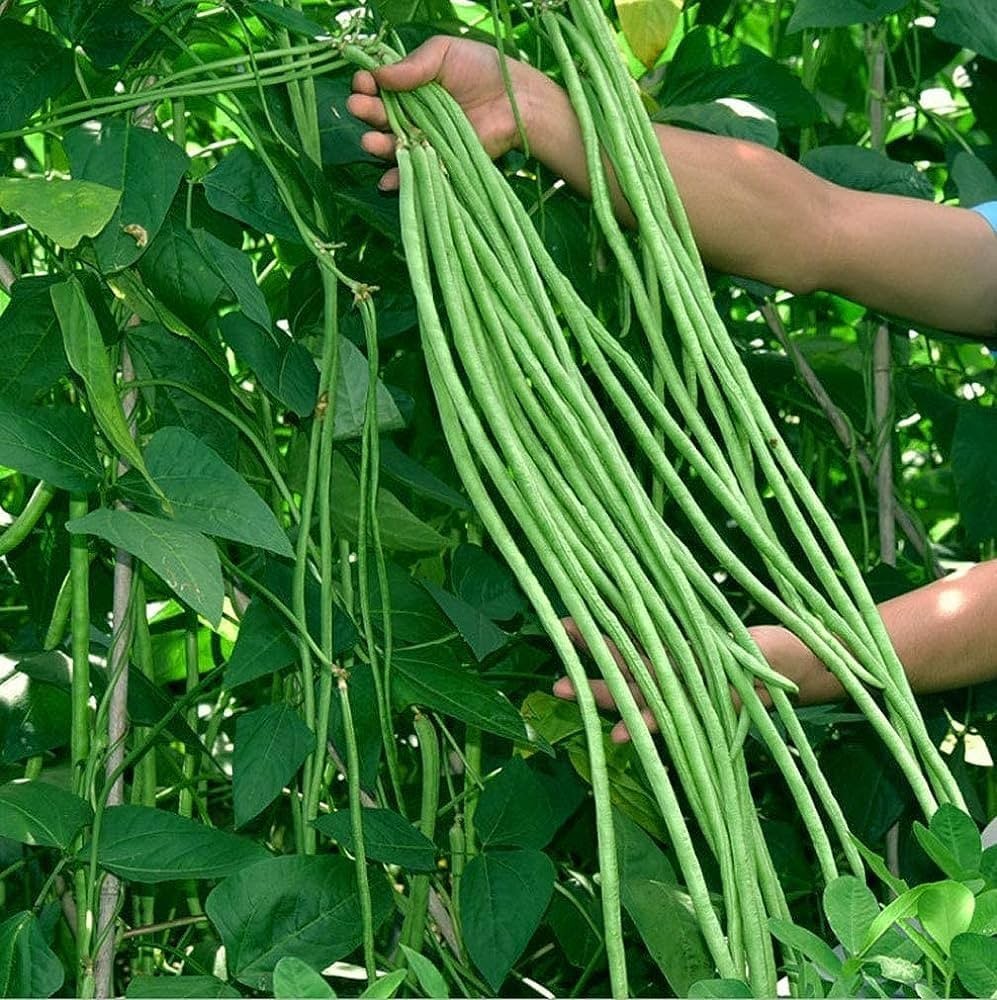
Hello there! Today, let's explore the familiar long pod in daily meals – Yardlong Bean (Vigna unguiculata subsp. sesquipedalis) – which is both a nutritious food and a valuable medicinal herb supporting various health conditions. Let's find out in detail together!
📸 [Photo 1 and 2 – Simulated and realistic images of the Yardlong Bean plant]


I. GENERAL INTRODUCTION TO THE YARDLONG BEAN PLANT
The Yardlong Bean (scientific name: Vigna unguiculata subsp. sesquipedalis) is an annual climbing vine, commonly cultivated for its pods as food. The green pods are 35 cm to 75 cm long and are usually cooked similarly to green beans. Yardlong beans yield fruit about 60 days after sowing, and pods are typically found in pairs on the plant.
🌱 Identification Characteristics
- • Roots and Stems: Strong root system with nitrogen-fixing symbiosis. Climbing stems (2-3m) or bush types (50-70cm), smooth and angled.
- • Leaves: Trifoliate leaves with oval or egg-shaped leaflets, light to dark green.
- • Flowers: Bisexual, clustered in leaf axils, white, pale yellow, or purple.
- • Pods and Seeds: Long capsule pods, chopstick-like cylinders (20-50cm). Kidney-shaped, small seeds, sweet and low in fiber when young.
II. HISTORY AND ORIGIN
Yardlong beans originate from tropical and subtropical regions in South and Southeast Asia, or derive from related subspecies in Africa before spreading globally. The domestication of this plant began over 6,000 years ago along with millet and sorghum in Africa, later spreading worldwide.
III. GROWTH CHARACTERISTICS AND IDEAL LIVING CONDITIONS
a. Ecological Characteristics
- Annual climbing vine, preferring warm climates.
- Long, nutritious pods with nitrogen-fixing capabilities that improve the soil.
b. Care Conditions for Healthy Growth
- 🌡️ Temperature: Ideal 25-35°C. The plant loves warmth.
- ☀️ Sunlight: Requires plenty of direct sunlight.
- 🌱 Soil: Porous, rich in organic matter, well-drained, pH 6.0-7.0.
- 💧 Watering: 75-80% humidity during flowering and pod development. Avoid waterlogging.
📸 [Photo 3, 4 and 5 – Dishes and applications of Yardlong Beans]


IV. NUTRITIONAL COMPOSITION AND DIVERSE USES
a. Nutritional Composition
- 🥩 Protein: Builds and maintains muscle mass.
- 🥗 Dietary Fiber: Supports digestion, prevents constipation.
- 🍊 Vitamins: C, A, B1, B2 boost immunity and protect eyes.
- 🦴 Minerals: Potassium, Calcium, Magnesium, Iron, Manganese, Copper.
- 🧬 Antioxidants: Protect cells.
b. Wonderful Uses
- 🍳 Food: Young pods stir-fried, boiled, cooked in soup, or made into pickles.
- 🌾 Agriculture: Short-term food crop, shading trellis, soil improvement.
V. PROPAGATION TECHNIQUES AND DETAILED CARE
a. Propagation
🌱 Seed Selection and Treatment:
- Choose plump seeds, free from pests, not empty or cracked.
- Soak seeds in warm water (2 parts boiling : 3 parts cold) for 2-3 hours.
- Wrap in a damp cloth until they sprout, then sow.
🌱 Soil Preparation and Sowing:
- Porous soil, weed-free, raised beds to prevent waterlogging.
- Holes 2-3cm deep, 25-30cm apart. Sow 1-3 seeds/hole, cover with a thin layer of soil, water adequately.
b. Care and Disease Prevention
- 💧 Watering: Regularly every day, 70% humidity. Increase water during flowering and pod development.
- 🏗️ Trellising: When plants reach 30cm, set up A-frame or upright trellises.
- ✂️ Pruning: Trim old leaves at the base for better ventilation.
- 🌾 Fertilizing: Top-dress with NPK when preparing to flower. Do not use fresh manure.
🛡️ Pest and Disease Management:
- Pod borers: Check carefully during flowering and fruiting.
- Aphids, thrips, red spider mites: Suck sap causing curled, yellow leaves.
- Leaf spot, root rot: Cause root rot and wilting in humid weather.
- Prevention: Field sanitation, solarizing soil, appropriate density, balanced fertilization, yellow sticky traps or biological preparations.
VI. REMEDIES SUPPORTING DISEASE TREATMENT
⚠️ Important Note:
These are folk remedies, lacking scientific proof, and are for reference purposes only.
- Parts used: Leaves, pods, seeds, roots.
- Harvest seasons: Spring-Summer (sow Feb-Mar, harvest Apr-May), Summer-Autumn (sow Apr-Jun, harvest Jun-Sep), Autumn-Winter (sow Aug-Sep, harvest Oct-Nov), Winter-Spring (sow Nov-Dec, harvest Jan-Feb).
- Preparation forms: Dried and fresh.
- Properties: Neutral nature, salty and sweet taste.
- Benefits: Tonifies spleen and stomach, boosts vital energy, nourishes kidneys, secures essence, supports digestion and cardiovascular health.
📝 Therapeutic Support Uses:
- Pods (young with pods, pod shells): Supports diabetes treatment, reduces thirst and frequent urination. Relieves back pain. Supports digestion.
- Seeds: Treats spermatorrhea, leukorrhea, night sweats, hematuria. Nourishes the body, strengthens the spleen, nourishes kidneys.
- Roots: Strengthens spleen and vital energy, aids digestion. Supports treatment of hemorrhoids, cloudy urine, acne and boils.
- Leaves: Decoction drunk to treat difficulty urinating, painful urination, dysuria.
🌱 Thank you for reading the article!
Hope you gained more useful knowledge about this nutritious green pod.
Don't forget to follow the blog to update with more interesting information!
📌 Share the article if you find it useful!


Comments (0)
No comments yet.
Leave a Comment