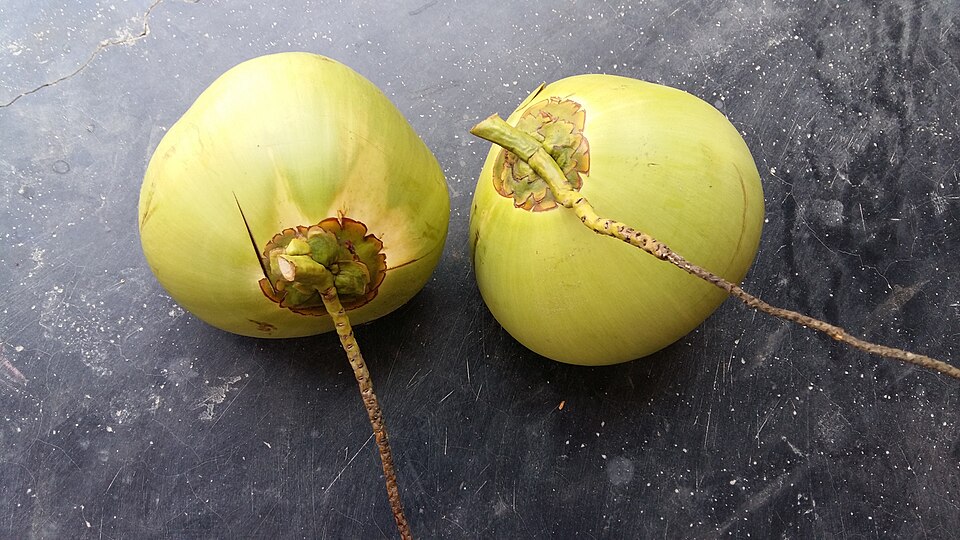
Hello! Today we explore the familiar tree that is synonymous with tropical regions – Coconut Tree (Cocos nucifera) – a tropical cultural icon providing food, fuel, cosmetics, folk medicine, and many other uses. Let's dive in!
📸 [Photo 1 & 2 – Simulated and real images of Coconut Tree]


I. INTRODUCTION TO COCONUT TREE
The Coconut Tree (scientific name: Cocos nucifera) is a woody plant, a member of the palm family (Arecaceae) and the only living species of the genus Cocos. Coconut trees are found throughout tropical coastal regions and are a tropical cultural icon. They provide food, fuel, cosmetics, folk medicine, and building materials, among many other uses.
🌱 Identification Features
- • Trunk: Large woody trunk, diameter 20-30cm. Many leaf scar rings, swollen at the base.
- • Leaves: Pinnately compound leaves, 30-35 fronds. Leaf sheaths are hard, hugging the trunk.
- • Roots: Fibrous root system, deep and wide, helping the tree withstand storms.
- • Flowers: Grow in bunches from leaf axils, both male and female flowers.
- • Fruit: Oval or round, growing in clusters. Has outer skin, fibrous husk, and hard shell. Takes 6-10 years for first fruit, 15-20 years for maximum yield.
II. ORIGIN AND DISTRIBUTION
The coconut tree originates from the Indian Ocean - Pacific region, stretching from Western Southeast Asia to Melanesia. This tree appeared thousands of years ago and spread widely across the globe thanks to the coconut's ability to float along ocean currents.
III. GROWTH CHARACTERISTICS AND IDEAL CONDITIONS
a. Ecological Characteristics
- Large woody tree, perennial, adapted to tropical coastal regions.
- Every part of the tree has practical value.
b. Care Conditions for Lush Growth
- 🌡️ Temperature: Ideal 20°C – 34°C. Below 15°C causes physiological disorders.
- ☀️ Light: Sun-loving, needs minimum 4 hours of sunlight/day.
- 💧 Rainfall and Humidity: 1,500-2,300mm/year. Humidity 80-90%, below 60% causes fruit drop.
- 🌱 Soil: Sandy loam, river alluvial soil, cultivation layer 0.5-1 meter, good drainage.
- ⛰️ Altitude: Below 500 meters above sea level.
📸 [Photo 3 & 4 – Savory dishes from Coconut]


📸 [Photo 5 & 6 – Savory dishes from Coconut]


📸 [Photo 7 & 8 – Savory dishes from Coconut]


📸 [Photo 9 & 10 – Savory dishes from Coconut]


📸 [Photo 12 – Coconut jelly]

📸 [Photo 13 & 14 – Coconut cakes]


📸 [Photo 15 – Coconut candy]

IV. NUTRITIONAL COMPOSITION AND VERSATILE USES
a. Nutritional Components
- 🥥 Coconut Water: 94% water, rich in Potassium, electrolytes, amino acids, vitamins.
- 🥥 Coconut Meat: High in fat, fiber, minerals.
- 🥥 Coconut Shell: Hard, used for crafts, activated charcoal.
- 🥥 Coir and Husk: Fiber, used for mats, ropes, growing medium.
- 🥥 Coconut Leaves: Roofing, weaving, crafts.
- 🥥 Coconut Trunk: Hard wood, construction, furniture.
- 🥥 Coconut Roots: Contain tannin, used in folk medicine.
b. Wonderful Applications
- 🍳 Culinary: Coconut water, meat, milk used in many savory and sweet dishes, beverages.
- 💄 Skin Care: Deep moisturizing, makeup removal, soothing skin.
- 💆 Hair Care: Hair repair, prevents dandruff.
- 🦷 Oral and Body Health: Teeth whitening, antibacterial, boosts immunity.
V. PROPAGATION AND CARE TECHNIQUES
a. Propagation
🌱 Selection of Mother Trees and Seeds:
- Select trees 10 years or older, yield over 100 fruits/year, disease-free.
- Select bunches with dry husks (brown), large uniform fruits, thin shells, no scars.
🌱 Seed Germination Technique:
- Store fruits in a cool place for 10-15 days.
- Prepare beds on sandy loam soil, 1.2-1.5m wide.
- Place fruits horizontally, pointed end up, 5-10cm apart, cover with straw, water regularly.
b. Care and Disease Prevention
- 🌱 Care: When sprouts reach 20-30cm with 2-3 leaves, carefully remove, plant in polybags or nursery for 3-6 months until 60-80cm tall, then transplant.
- 🛡️ Cultivation and Biological Measures: Garden hygiene, proper planting density (6x6 to 7x7 meters), use natural enemies, apply adequate N,P,K and increase Potassium.
- 🛡️ Pest and Disease Control: Stem borers, black-headed caterpillars, coconut beetles, leaf sheath fungi, white fungi.
VI. FOLK REMEDIES
⚠️ Important Note:
This is a folk remedy without scientific validation – for reference only.
- Parts used: Leaves, fruit, roots.
- Harvest season: Year-round, bunches harvested 18-20 days apart.
- Preparation: Can be used fresh or dried.
- Taste & Nature: Sweet taste, neutral nature.
- Uses: Cooling, calming, and detoxifying.
📝 Health Support Benefits:
- Hydration and Electrolytes: Restores energy quickly and effectively quenches thirst.
- Heart Health: Potassium helps regulate blood pressure, reduces heart disease risk.
- Kidney Stone Prevention: Dilutes urine, reduces crystal accumulation.
- Skin Beauty: Antioxidant, moisturizing, acne prevention.
- Digestive Health: Supports digestion, balances gut microbiome.
- Menstrual Support: Hydration, reduces cramps, supports menstrual flow.
🌱 Thank you for reading!
We hope you found useful information about this "tree of life".
Don't forget to follow our blog for more interesting content!
📌 Share if you found this helpful!



Comments (0)
No comments yet.
Leave a Comment