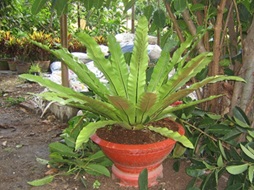
Hello! Today we explore the special fern called Bird's Nest Fern (also known as Nest Fern) – an elegant ornamental plant, a nutritious food, and a source of valuable folk remedies. Let's dive in!
📸 [Photo 1 & 2 – Simulated and real images of Bird's Nest Fern]


I. INTRODUCTION TO BIRD'S NEST FERN (ASPLENIACEAE)
The Bird's Nest Fern, with its poetic names like Nest Fern, is a special fern species belonging to the family Aspleniaceae. Unlike many other ornamental plants, it carries a wild yet elegant beauty, making it a popular choice for interior decoration.
🌱 Identification Features
- • Rhizome: Short, creeping or firmly attached to the substrate.
- • Leaves: The highlight – large, thick, forming a rosette that spreads out like a bird's nest. Petioles are short and thick, covered with long scales at the base. Leaf blades are lanceolate, 30-90cm long, 5-10cm wide, pale green with entire or slightly wavy margins.
- • Sori: Thin, arranged obliquely to the midrib on the underside. Spores are oval, bright yellow.
II. ORIGIN AND DISTRIBUTION
As one of the most ancient plant species, the ancestors of the Bird's Nest Fern appeared about 300 – 400 million years ago in tropical rainforests.
Today, this fern is primarily distributed in tropical and subtropical regions, spanning from Asia, Oceania to the Indian Ocean islands. Southeast Asia (especially Thailand and Vietnam) and Southern China have the highest concentrations.
III. GROWTH CHARACTERISTICS AND IDEAL CONDITIONS
a. Ecological Characteristics
- This is an epiphytic plant, without woody stems. In nature, it grows on tree trunks or moist rocky cliffs.
- The nest-like rosette is an adaptation that helps collect humus, leaf litter, and rainwater to nourish the roots.
b. Care Conditions for Lush Growth
- 🌡️ Temperature: Ideal 22°C – 28°C. Can tolerate >30°C with high humidity.
- 💧 Humidity: Prefers high humidity. Mist regularly if placed in air-conditioned rooms or set pot on wet pebble tray.
- ☀️ Light: Prefers partial shade or filtered light. Avoid direct sunlight which can scorch leaves.
📸 [Photo 3 & 4 – Dishes or decorative spaces featuring Bird's Nest Fern]


IV. NUTRITIONAL COMPOSITION AND VERSATILE USES
a. Outstanding Nutritional Value
- 🥗 High Dietary Fiber: Supports digestion and improves bowel movement.
- 🍊 Rich Vitamins: High in Vitamin C, A, and B-complex – boosting immunity.
- 🦴 Essential Minerals: Provides Potassium, Iron, Calcium for strong bones and body function.
- 🧬 Powerful Antioxidants: Polyphenols, Flavonoids, p-coumaric acid – protecting cells, anti-aging, antibacterial.
- 💆 Fucose-rich Mucilage: Hydrates, improves skin elasticity, and promotes collagen production.
b. Wonderful Applications
- 🍳 Culinary: Young leaves have a crunchy, slightly sweet taste. Used in stir-fries, boiled dishes, or soups. Blanch briefly to reduce mild bitterness.
- 🏠 Decoration & Feng Shui: Purifies air and brings good luck and prosperity.
- 💊 Health Support: Traditionally used for headaches, hair and scalp issues, and to relieve sprains and dislocations.
V. PROPAGATION AND CARE TECHNIQUES
a. Propagation
🌿 Division Method:
- Select healthy mother plants with many offshoots and developed roots.
- Timing: Early spring or early rainy season.
- Method: Divide into clumps with at least 2-3 leaves and healthy roots. Apply lime or fungicide to cuts. Plant in loose, humus-rich substrate with 50-70% shade netting.
🧬 Spore Sowing:
- Harvest spores when sori turn brown/black.
- Sow on moist substrate surface, do not cover with soil (light needed for germination).
- Cover with plastic lid or transparent bag to retain moisture. After 3-4 weeks, tiny plantlets appear.
📸 [Photo 5 – Spore illustration or sowing process]

b. Care & Disease Prevention
- 💧 Watering: 2-3 times/week, water around the base. Avoid watering the center to prevent rot.
- 🌱 Nutrition: Use well-draining substrate, pH 5.5-6.5. Apply diluted NPK or worm castings once monthly. Do not apply granular fertilizer at the center.
- 🧹 Pest Control: Wipe leaves with damp cloth, remove yellow/diseased leaves.
VI. FOLK REMEDY FOR HAIR LOSS
⚠️ Important Note:
This is a folk remedy without scientific validation – for reference only.
- Part used: Whole plant (fresh leaves preferred).
- Harvest: Year-round.
- Preparation: Can be used fresh or dried.
- Properties: Bitter taste, warm nature.
- Traditional uses: Strengthens bones and tendons, activates blood circulation, promotes diuresis.
📝 Hair Rinse Recipe:
- Step 1: Take 30–50g fresh leaves, wash and cut into pieces.
- Step 2: Boil with 2 liters of water for 15 minutes to extract active compounds.
- Step 3: Let cool slightly, use to wash and soak hair, do not rinse with cold water. Be consistent for results.
🌱 Thank you for reading!
We hope you found this information useful!
Don't forget to follow our blog for more interesting content!
📌 Share if you found this helpful!


Comments (0)
No comments yet.
Leave a Comment